
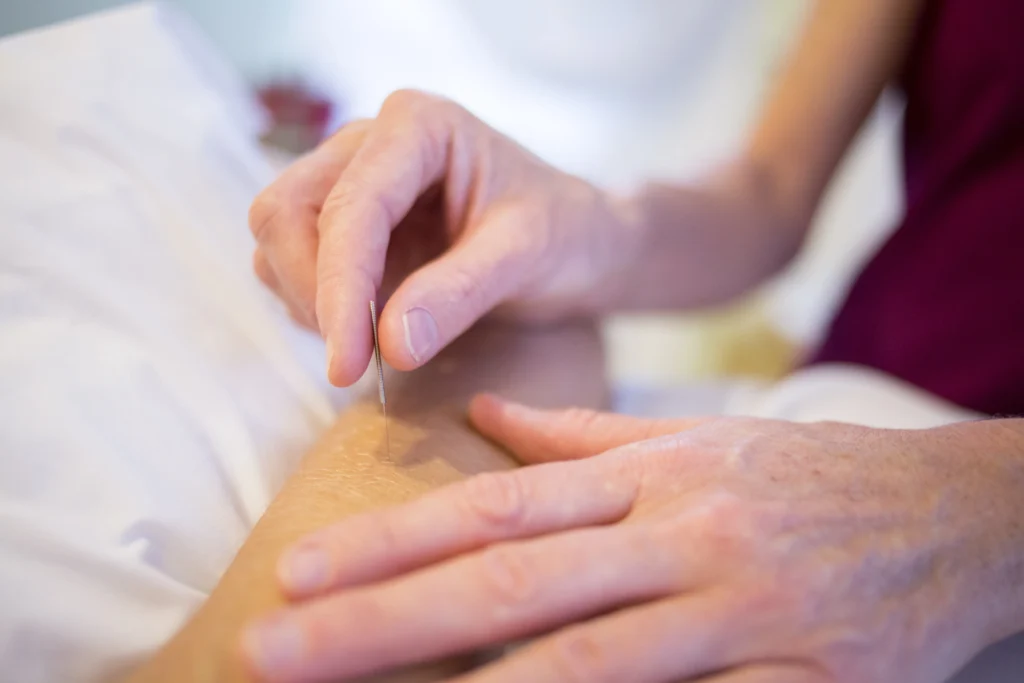
Most people considering acupuncture for the first time have the same two questions: what actually happens, and does it hurt. Neither gets answered well by a list of services, so here is the session itself, start to finish.
Before your first session: the initial assessment
Your first appointment is longer than the ones that follow, and most of it is conversation rather than treatment. The practitioner will ask about the problem that brought you in, but also about things that seem unrelated:
- Sleep patterns
- Digestion and appetite
- Energy levels through the day
- Stress and mood
In traditional Chinese medicine these are read together rather than in isolation, which is why the questions range wider than you might expect. You may also be asked to show your tongue and have your pulse taken at both wrists. Both are standard diagnostic steps in this tradition and take a few seconds each.
Before you come, make a note of:
- Any medication you take, including supplements.
- Whether you are pregnant or think you might be.
- Whether you take blood thinners.
- Whether you have a pacemaker or any implanted device.
None of these necessarily rules out treatment, but they change how it is approached.
What happens during an acupuncture session?
You will lie on a treatment couch, face up or face down depending on where the needles are going. Only the area being treated is uncovered, and a towel covers the rest. Loose clothing makes this easier, which is why it is worth wearing something you can move out of the way.
Then come the needles:
- Single-use and sterile, disposed of straight after the session.
- Roughly the width of a hair, far finer than those used for injections or blood tests.
- Between five and twenty per session is typical.
- Inserted quickly, to a shallow depth.
- Left in place for around twenty minutes while you rest.
The practitioner may return during that time to adjust or gently rotate them. The whole appointment usually runs to forty-five minutes or an hour, with the first one longer.
Does acupuncture hurt?
This is the question that stops most people from booking, so it is worth answering plainly. Insertion is usually felt as a brief prick, or not at all. Once the needle is in place, the more common sensations are:
- A dull ache.
- A feeling of heaviness.
- Warmth around the point.
- A slight tingling that spreads outwards.
In Chinese medicine this response has its own name, de qi, and it is considered a sign the point is active.
None of it should be sharp or persistent. If something feels genuinely painful, say so and the needle is adjusted or removed. Most people find the twenty minutes with the needles in place surprisingly restful, and some doze off.
Meet the practitioner
Acupuncture at Midtown Clinic is carried out by Dr Jing Qiao, a specialist in traditional Chinese medicine who also practises acupressure, cupping and scraping therapy.
Dr Qiao works from the principle that ancient practice and modern healthcare are not in opposition. Treatment is built around the individual rather than applied from a fixed protocol, with an emphasis on long-term wellbeing and prevention as much as on the problem that brought you in.
What happens after your session?
Most people carry on with their day normally. Occasional small bruises at needle sites are harmless and fade within a few days.
There is nothing you have to do afterwards, but a few things help:
- Drink plenty of water.
- Skip heavy training.
- Avoid a heavy meal straight afterwards.
- Take it easy for the rest of the day.
Acupuncture is not usually a one-off. Practitioners typically work in courses of several sessions, spaced weekly at first and then further apart, with the plan reviewed as you go. How many you need depends on what you came in for and how you respond. Your practitioner will discuss it at the first appointment.
Acupuncture, cupping or acupressure: how they differ?
These often get grouped together, but they are different techniques.
| Technique | What it involves |
|---|---|
| Acupuncture | Fine needles inserted at specific points. |
| Acupressure | Manual pressure applied to those same points, no needles. |
| Cupping | Suction cups placed on the skin, usually across the back and shoulders. |
| Scraping therapy (gua sha) | A smooth-edged tool drawn along the skin to stimulate the surface. |
Which is appropriate depends on your situation and is decided at the assessment. All four are available as part of our Chinese medicine services at Midtown Clinic in Gibraltar.
Booking your first session at Midtown Clinic
Appointments can be booked by calling reception on +350 200 62222. No GP referral is needed.
More info at Contact page.
Common questions about acupuncture sessions
How long does an acupuncture session last?
Around forty-five minutes to an hour, with the first appointment longer because of the initial assessment.
Are needles reused between different acupuncture sessions?
No. All needles are sterile, single-use and disposed of immediately after treatment.
What should I wear?
Loose, comfortable clothing that is easy to move out of the way. You will not usually need to undress fully.
Do I need a referral?
No. You can book directly by calling reception on +350 200 62222. Appointments are available on a self-pay basis or through the insurers Midtown Clinic works with.